Skip to content
whatsinyourvial.com

How to read a COA.

A Certificate of Analysis (COA) is the lab report that’s supposed to prove what’s in your vial. A testing lab takes a sample from one batch, checks what it is, how pure it is and how much is there, then signs off on the results.

For most peptides you buy, it’s the only proof you’ll ever see. A good COA lets you check the seller’s claims for yourself. A bad one can look just as official while describing the wrong product, a different batch, or results copied from somewhere else.

Below: what a good one looks like, what a bad one looks like, a six-step check you can run on any COA in about two minutes, and COA 101 to learn the language.

What a good COA looks like, next to real ones that fall short.

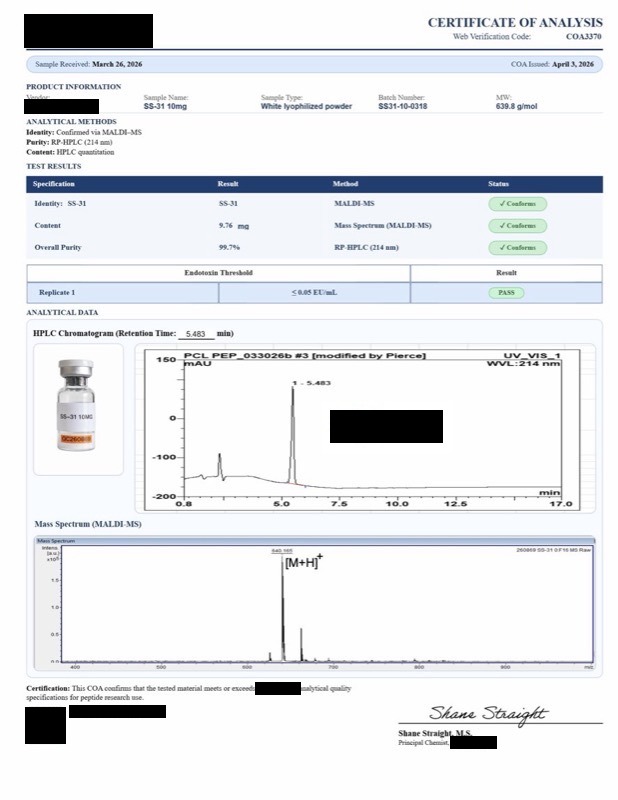
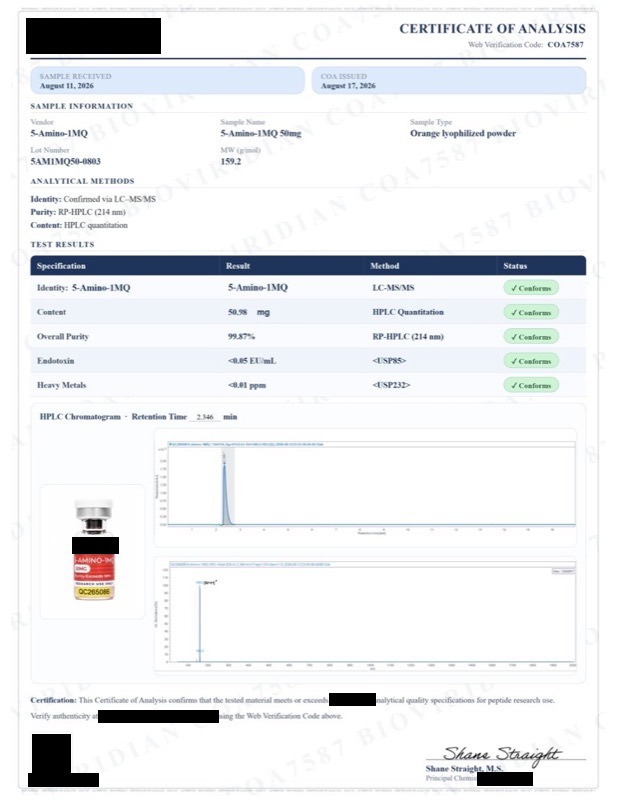
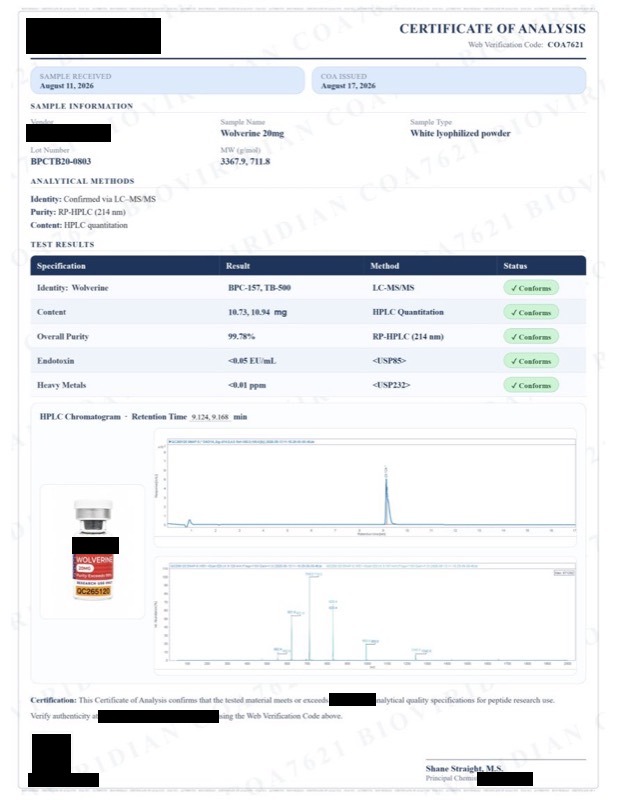
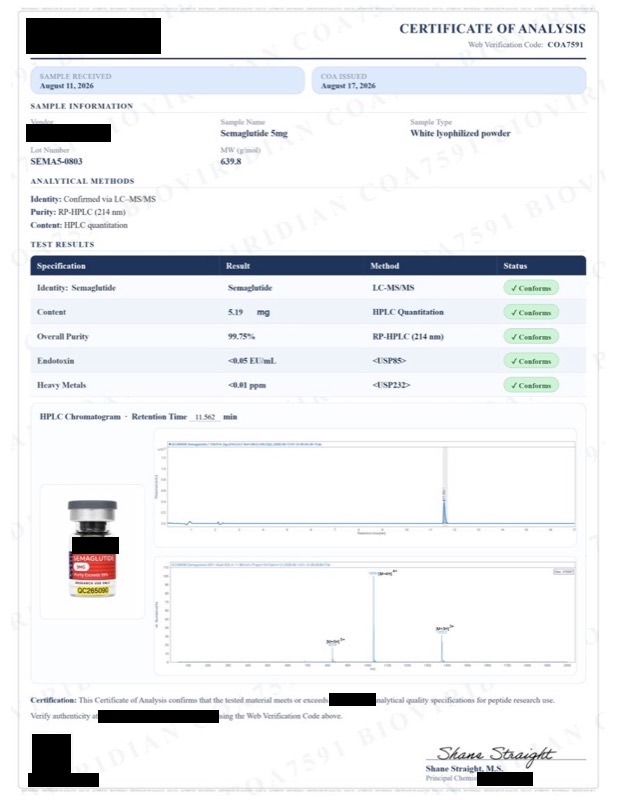
Hover or click each number to reveal its explanation, and scroll the bad side for the next COA. The four bad examples are real certificates one seller published on its own website in 2026. In most of them the lab data looks genuine; the problems are in the paperwork.

✓ Good · how it should look
Illustration · green flags
Example Analytical LaboratoryTesting lab, not the seller · full street address
ISO/IEC 17025 accredited · Cert. No. 0000.01
Certificate of AnalysisReport EAL-26-04417 · Page 1 of 2
Verify at the lab’s own website
ClientSeller name
SampleBPC-157 · 10 mg/vial
LotBPC10-260803
Received → testedAug 5 → Aug 6–20
IssuedAug 24, 2026
TestMethodSpecificationResultStatus
IdentityLC-MS (ESI)MW 1419.5 ± 1 Da1419.6 DaPass
PurityRP-HPLC 214 nm≥ 98.0%99.41%Pass
ContentHPLC vs. reference std.9.50–10.50 mg10.08 mg (100.8%)Pass
EndotoxinKinetic LAL, USP <85>Report only0.42 EU/mg (LOQ 0.05)Reported
SterilityUSP <71>, 14-dayNo growthNo growth, day 14Pass
EAL-26-04417 · BPC-157 · Lot BPC10-260803 · 2026-08-06 14:32
RT 7.42 min · 99.41% 710.8 [M+2H]2+ 1420.5 [M+H]+ HPLC, 214 nm Mass spectrum
AnalystSigned · Aug 21, 2026
QA reviewer (independent)Signed · Aug 24, 2026

Text-based PDF from the lab’s own system. Illustration only: a composite of what a complete certificate contains, not a real lab, report or product.

✕ Bad · real certificates
August certificate for Wolverine Blend (BPC-157 + TB-500), lot BPCTB20-0803, with six red flags pinned.
Semaglutide 5 mg certificate, lot SEMA5-0803, with four red flags pinned.
SS-31 10 mg certificate, batch SS31-10-0318, with four red flags pinned.
5-Amino-1MQ 50 mg certificate, lot 5AM1MQ50-0803, with four red flags pinned.

Check any COA yourself in six steps.

A COA is often the only evidence you get of what’s in a vial, and a wrong one looks just as official as a right one. If it’s wrong, you can’t know the identity, strength or purity of what you’re using. These six checks catch most problems before you buy.

Step 01Header + spectrum
HEADER MW 1000.0 +1 SPECTRUM 1001.0

Do the weight math.

The weight printed in the header must match the peaks in the mass-spec chart.

Try the calculator ↓

Look at: the MW in the header and the tallest peak

How the math works

One tall peak: look for the printed weight + 1.

A row of peaks: each peak is (weight + n) ÷ n. A 4,000 Da peptide shows up near 2,001, 1,334 and 1,001. If no peak fits the printed weight, the chart and the header describe different samples.

Step 02Dates
MADERECEIVEDISSUED 14-DAY TEST

Check the dates.

Received → tested → issued must run in order, with enough time for every test listed.

Look at: received, issued and every test listed

Lot code looks made up?

Sellers write their own lot codes, so a date inside one proves nothing. Check dates that are harder to fake:

  1. The chart’s run time. The banner on the chart prints when the instrument ran. It must fall between “received” and “issued”.
  2. The lab’s own records. Look the report number up on the lab’s website, or email the lab (not the seller). The sample, lot and dates should match.
  3. The PDF’s creation date. On a Mac: open in Preview, then Tools → Show Inspector. In Acrobat: File → Properties. A file made months after the issue date, or before the sample arrived, needs an explanation.

Rapid sterility methods can finish in 4–6 days, but the certificate has to name the method.

Step 03Lot number
A-01 BATCH 1:1 LOT A-01

One lot, one set of results.

Search the seller’s COAs for your lot number. A real batch has one purity and one story.

Look at: every COA the seller posts for your lot

Why it matters

If two certificates share a lot number but disagree, at least one of them isn’t describing that batch. Re-using a lot code with new numbers is never normal.

Step 04Chart banner
YOUR-PRODUCT · LOT A-01 · 10:12

Read the chart’s fine print.

Zoom in on the small banner at the top of each chart. It should name your product.

Look at: the small text at the top of each chart

Why it matters

The banner is written by the instrument at the moment of the test. If it names a different compound, the chart was borrowed from another product’s run.

Step 05Results table
10mg LABEL 89101112 MG 9.9 MG ±5%

Compare content to the vial size.

“Content” is how much peptide was measured. It should be within about 5–10% of the label.

Look at: the content row next to the vial size

Why it matters

Content tells you how much peptide is actually in the vial. A number that’s far off, or obviously mistyped, means nobody re-read the certificate before it shipped.

Step 06Results table
BATCH 1BATCH 2BATCH 3 0.210.340.18 EU/mg

Distrust identical numbers.

Real tests give slightly different results every batch. Identical rows are template filler.

Look at: endotoxin and metals across certificates

One more to watch for

“Identity confirmed by LC-MS/MS” above a chart with no fragment peaks. That test produces fragments; without them, the claim is bigger than the evidence.

Step 01Calculator

Check the weight math.

Try:

Runs in your browser. Nothing is sent anywhere.

Where the peaks should be

Enter the weight printed in the COA header.

Close is good enough: labs round differently, so a match within about 1 (more for big peptides) counts. A header listing a salt form (e.g. acetate) can read about 60 higher per acetate than the chart.

COA 101: learn the language.

Molecular weight (MW)
How heavy one molecule is. Every peptide has its own weight, like a fingerprint. The lab’s chart should show that same number.
Mass spectrum (MS)
A chart from an instrument that weighs molecules. The tall peak should land on the peptide’s weight. A label like [M+H]+ just means “the weight plus one.”
HPLC and purity
An instrument that separates a sample into its parts and draws a peak for each one. Purity is how much of the sample is the main peak: the thing you paid for.
Content
How many milligrams of peptide the lab actually found in the vial. It should be close to the number on the label.
Lot number
The name for one batch made at the same time. Every vial in that batch shares it, and the batch should have just one set of test results.
Endotoxin (LAL)
A test for leftover pieces of bacteria. A real test gives an actual measured number.
Sterility (USP <71>)
A test to see if anything grows in the sample, like bacteria or mold. The standard test takes 14 days.
ISO/IEC 17025
A certificate a lab earns by passing outside inspections. It shows the lab follows the rules. You can look up a lab’s number online.
Want a second pair of eyes on your COA?

Send us one vial from your current supplier and we’ll test it — or bring your supplier’s certificate to a 15-minute call and we’ll go through it line by line.